For a parent, having a baby in the neonatal intensive care unit (NICU) can be an extremely worrisome experience. For a healthcare provider, treating these tiny, fragile babies swiftly and accurately is of the utmost importance to ensure they are able to go home to their families as soon as possible. However, many NICU clinicians face an obstacle that should be simple but often isn’t—a blood test.
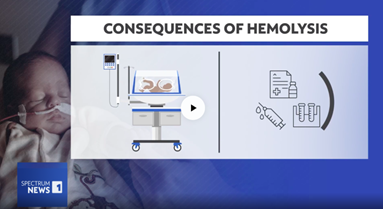 Studies show that up to 46.4%[1] of all blood tests conducted on babies in the NICU are hemolyzed, resulting from the inadvertent destruction of red blood cells in a sample, during or after the blood draw. Hemolysis causes an increase in potassium[2] in the sample, which can lead to inaccurate test results. Additionally, because many neonates cannot afford additional blood loss, repeated blood tests when hemolysis is suspected, but not confirmed, is often not a viable option[3]. These reasons make hemolysis detection at the point of care critical.
When you’re dealing with premature infants or just babies in general, you are limited to how much blood you can draw. You might need to make clinical decisions and treatment decisions based on that result. If you don’t know that it’s (hemolysis) there, that could go missed and negatively impact the patient.”
- Robert Maynard, PhD, UK HealthCare
Spreading Awareness and Sparking Change in Kentucky
At the University of Kentucky, clinicians are doing their part to spread awareness of the impact and prevalence of hemolysis, as well as educate others about solutions that can help. Recently, Spectrum News 1 Kentucky Reporter Geraldine Torrellas spoke with Dr. Robert Maynard, Assistant Professor of Pathology and Laboratory Medicine, and Dr. Sanchayan Debnath, a Neonatologist and Assistant Professor of Neonatology, who are among the first in the country to use the GEM® Premier™ 7000 with iQM®3, the first blood gas system that detects hemolysis at the point of care (POC).
Prior to the system’s introduction in 2024, there was no immediate way for healthcare providers to determine if a specimen was hemolyzed. Rather, they needed to wait for a result to return from the central laboratory, a time-consuming process that could take hours. Now, with the GEM Premier 7000, the University of Kentucky can test every blood gas sample in the NICU and detect the presence of hemolysis, to help ensure accurate results in one minute. This helps them make faster and more accurate diagnoses and management decisions — especially critical when caring for babies in the NICU.
For more information about the groundbreaking care that the University of Kentucky is providing by instituting hemolysis detection at the POC, check out the full Spectrum News 1 Kentucky segment here.
G7K Spectrum1KY CB WW Rev00 3.25


